



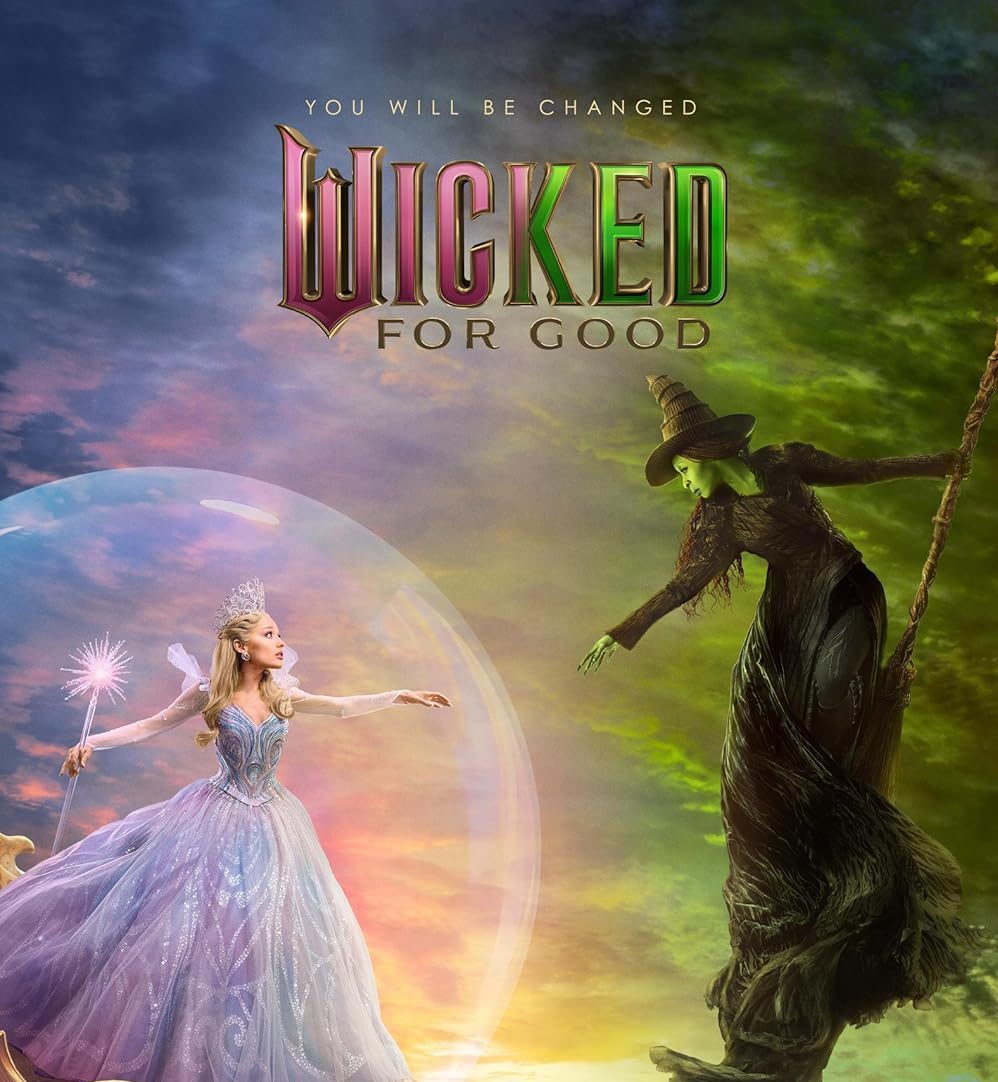
Last time we saw green outcast Elphaba Thropp (Cynthia Erivo) and her polar opposite frenemy Glinda (Ariana Grande), they were dueting “Defying Gravity” as Elphaba floated above the Emerald City on her broomstick. The movie ended with Elphaba and Glinda going their separate ways after they discover the revered Wizard of Oz (Jeff Goldbloom) wasn’t so wonderful after all.
Following the emotional ending of the 2024 “Wicked: Part 1,” now enlightened Elphaba began her mission of restoring animal free speech, while Glinda decided to continue her sheltered life, partnering with the Wizard to appear as a symbol of good for the ignorant citizens of Oz. This dilemma is where the musical fantasy “Wicked: For Good” opens. The first scene features a propaganda speech by the Oz press secretary, Madame Morrible (Michelle Yeoh), demonstrating her role as the real Wicked Witch. Yeoh explained Madame Morrible’s character better herself, saying in multiple recent interviews, “Madame Morbile, flip it around, Wicked Witch!” Madame Morrible’s propaganda, whether it’s in the form of pamphlets or speeches broadcast across Oz, is consistently used as a pro-capitalist, anti-Elphaba tool throughout the screentime of “Wicked: For Good.” Constant propaganda partnered with Goldbloom’s portrayal of the Wonderful Wizard of Oz as a foolish, “can’t we all get along?” dictator, “Wicked: For Good” successfully transformed into a political commentary.
After the opening of the film’s elaborate song “Everyday More Wicked,” we get an insight into Elphaba’s life as an outcast. Living in a hollow tree, Elphaba spends her days collecting propaganda posters and plotting against the Wizard’s regime. Meanwhile, on the opposite side of Oz, glittery Glinda and her fiancé, the head of Oz’s special forces, Prince Fieryo (Jonathan Bailey), celebrate the opening of the Yellow Brick Road. In Oz, all roads should lead to the wizard after all.
While the ignorant citizens of Oz celebrate, many animals are planning to leave Oz as a result of the Wizards’ authoritarian control over speech. Seeing this, Elphaba goes to the Wizard’s Emerald Palace to convince the stubborn dictator to proclaim himself a liar to Oz and end the oppression of animals. The Wizard responds with an offer of partnership, singing, in my opinion, the best song of the film, “Wonderful,” claiming that “The truth is not a thing of fact or reason, the truth is just what everyone agrees on.” Elphaba originally accepts his offer, but after the head flying monkey shows her animals caged by the Wizard, including Elphaba’s former Shiz professor, Doctor Dillamond, she leaves the Wizard’s palace, fueled with more rage than before.

This is where the plot of Victor Fleming’s 1939 film “The Wizard of Oz” appears. Dorothy arrives notoriously by tornado, takes the Wicked Witch of the East’s shoes, and is sent on her Yellow Brick Road journey by Glinda. When Dorothy arrives in the Emerald City, the Wizard tells her that she can only be sent back to Kansas after the Wicked Witch of the West is proven dead by the return of her infamous broomstick. Dorothy, Tin-coated Boq, the cowardly lion, and scarecrowified Fieyro head off to kill Elphaba. When Glinda gets wind of this vengeful journey planned against her former friend, she leaves Emerald City immediately to save Elphaba. After her arrival, Elphaba and Glinda duet the heartwarming lyrics of “For Good,” included in the film as a live performance by Erivo and Grande.
Even after this heartfelt finale, I must admit, “Wicked: For Good” was not a whimsical successor to the Ozian spectacle that is “Wicked: Part 1”, but wasn’t that the point? Chu, director of the “Wicked” duology, reshaped the 2003 Winnie Holzman musical with allusions to modern United States politics, creating a theme for viewers to think about after the credits roll.
This film deserves a degree of cynicism concerning its new political themes. It is, after all, a second act. Skepticism of this film’s added political edge fits into a larger conversation that began when it was announced that the original two-hour and 45-minute Broadway production would be sprawled across two separate films, totaling an approximate five-hour runtime. “Give us a clock tick?” is an Ozian phrase consistently used throughout the film, but after spending nearly three hours in a movie theater, it felt like much longer than that.
Whether the overwhelming length of “Wicked: For Good” was a choice driven by art or commerce, the screentime was extended to include more musical creativity for the film’s composer. At 44 minutes and 52 seconds, the soundtrack adds over 15 minutes of music to the runtime of the original Broadway cast recording’s second act, including two brand new, Oscar-nominated songs. Though these song additions slightly interrupted the original flow of the musical accomplished by the “Wicked” Broadway cast, they were perfectly tailored to complement Erivo and Grande’s voices, giving them their time to shine as singers.“The Girl in the Bubble” even granted Grande her notorious whistle note.
These inclusions contributed to the musical-films nominations for multiple awards in 2026 including Critics Choice Awards, Best Picture, and the Golden Globes, Cinematic and Box Office Achievement. “Wicked: For Good” defied gravity by my standards. It was made with love, incorporating strong political themes and new additions to customize the iconic Broadway production into a heartwarming film tied up neatly with a pink bow that even Glinda approves of.


